

Stalking & Violation of Injunction Defense in Florida
Accused of Stalking or Violating an Injunction in Florida? A Single Message or Misstep May Trigger Felony Consequences
A text message. A social media reaction. Driving past a place you’ve been to a hundred times.
What may feel minor—or even unintentional—can quickly become a serious criminal allegation in Florida.
Now you are facing accusations of stalking or violating an injunction.
These cases are often highly emotional and fast-moving. They may involve former partners, family members, or ongoing disputes. And once an injunction is in place, even indirect or third-party contact may be interpreted as a violation.
The stakes can escalate quickly—especially when the allegations involve threats, repeated conduct, or prior court orders.
Jail or prison exposure. A permanent criminal record. Loss of firearm rights. Strict court-ordered restrictions that impact where you can go, who you can see, and how you communicate.
And the narrative may be built early—based on messages, screenshots, and one side of the story.
At RHINO Lawyers, we focus on defending individuals across Florida who are facing stalking or injunction-related charges that may impact their freedom, their reputation, and their future.
What Is Stalking Under Florida Law?
Stalking generally involves willfully, maliciously, and repeatedly following, harassing, or cyberstalking another person.
You can review the law under Florida Statutes §784.048.
To prove stalking, the prosecution typically must show:
- A course of conduct directed at a specific person
- Repeated actions or communications
- Conduct that causes substantial emotional distress
Intent and repetition are key.
A single incident is usually not enough—but a pattern may be.
CONTACT YOUR FLORIDA CRIMINAL DEFENSE ATTORNEYS
Let RHINO Lawyers’ former State Attorneys and Prosecutors start helping YOU immediately by giving you free advice regarding the facts of your case.
So, get YOUR Free Case Analysis now by texting us, chatting with us online, completing the form below, or by calling 844.RHINO.77.
When Stalking Becomes a More Serious Criminal Charge
Florida Statute §784.048 distinguishes stalking from aggravated stalking.
Stalking — First-Degree Misdemeanor
A person who willfully, maliciously, and repeatedly follows, harasses, or cyberstalks another person commits stalking, a first-degree misdemeanor.
Aggravated Stalking — Third-Degree Felony
Aggravated stalking is a third-degree felony in several situations, including when a person:
- willfully, maliciously, and repeatedly follows, harasses, or cyberstalks another person and makes a credible threat;
- knowingly, willfully, maliciously, and repeatedly follows, harasses, or cyberstalks a person after certain protective injunctions or other court-imposed prohibitions are in place; or
- willfully, maliciously, and repeatedly follows, harasses, or cyberstalks a child under 16 years of age.
A credible threat may be verbal or nonverbal and must place the target in reasonable fear for the safety of the target or specified people closely associated with the target. Florida law does not require proof that the person making the threat actually intended to carry it out.
Criminal Violations of a Stalking Injunction
A willful violation of a stalking or cyberstalking injunction through conduct specifically prohibited by §784.0487 is generally a first-degree misdemeanor. Examples listed in the statute include prohibited direct or indirect communication, entering specified restricted areas, stalking the petitioner, certain threats or acts of violence, and refusing to surrender firearms or ammunition when ordered by the court.
If a person has two or more prior convictions for violating an injunction or qualifying foreign protection order and then violates an injunction or protection order against the same victim, the new offense is a third-degree felony.
Whether particular conduct also supports an aggravated-stalking charge depends on whether the separate elements of §784.048 are met.
What Is an Injunction in Florida?
An injunction—often called a restraining order—is a court order that restricts contact and behavior.
Common types include:
- Domestic violence injunctions
- Dating violence injunctions
- Repeat violence injunctions
- Stalking or cyberstalking injunctions
These orders may include:
- No direct or indirect contact
- Stay-away distances (home, work, school)
- Prohibitions on social media interaction
Even indirect contact—through friends, family, or online activity—may be considered a violation.
What Counts as a Violation of an Injunction?
Violating an injunction generally involves failing to follow the court-ordered restrictions.
This may include:
- Texting, calling, or messaging
- Responding to the protected person—even if they initiated contact
- Contact through third parties
- Showing up at restricted locations
- Engaging on social media (likes, comments, tags)
Key issue:
The violation must be knowing and willful—but interpretation can be broad.
When Injunction Violations Become More Serious Charges
Many people assume injunction violations are minor. That is not always the case.
- Repeat violations may lead to enhanced penalties
- Violations tied to stalking behavior may be charged as felonies
- Violations involving threats or intimidation may escalate quickly
Even a case that begins as a misdemeanor may become a felony with additional allegations.
What Happens After an Arrest or Allegation?
These cases often move quickly—and may feel overwhelming.
Arrest or Warrant
You may be arrested based on:
- A complaint from the protected person
- Law enforcement review of messages or activity
First Appearance
A judge reviews:
- Charges
- Bond conditions
- No-contact provisions
Bond may include strict no-contact conditions—even beyond the injunction.
No-Contact Orders
You may be ordered to have:
- Zero communication
- No presence near specific locations
Violating these conditions may lead to additional charges.
Injunction Hearing (Critical Stage)
A separate hearing determines whether the injunction becomes permanent.
This hearing may shape:
- Long-term restrictions
- Future criminal exposure
Criminal Case Process
This may include:
- Evidence review (messages, logs, digital records)
- Motions challenging admissibility
- Negotiations or trial
Early legal action may influence outcomes significantly.
How These Cases Are Investigated
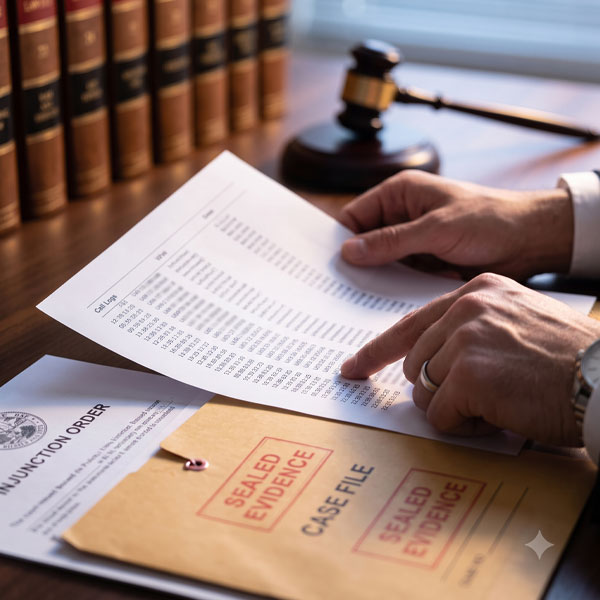
Stalking and injunction cases are often evidence-heavy and digital.
Evidence may include:
- Text messages and screenshots
- Emails and DMs
- Social media activity
- Call logs and location data
- Witness statements
For investigative standards, the Florida Department of Law Enforcement provides guidance on criminal investigations.
But here’s the reality:
Digital evidence can be misleading.
- Messages may be taken out of context
- Screenshots may be incomplete
- Conversations may be one-sided
Context is everything.
Key Legal Issues in Stalking and Injunction Cases
Was the Conduct Truly Repeated?
A pattern is required for stalking. Isolated incidents may not meet the legal standard.
Was There Intent to Harass or Threaten?
Intent is critical—especially in felony cases.
Was the Contact Knowing and Willful?
For injunction violations, accidental or incidental contact may be disputed.
Were the Injunction Terms Clear and Specific?
Ambiguous orders may create confusion.
Was There a Credible Threat?
In felony stalking cases, whether a threat was “credible” is often contested.
Common Defense Strategies
Every case depends on its facts. However, several defenses may apply.
Lack of Intent
If there was no intent to harass or threaten, that may affect the more serious penalties.
Accidental or Incidental Contact
Unintentional contact may not meet the legal threshold.
No Pattern of Conduct
A single or limited number of interactions may not qualify as stalking.
Misinterpretation of Communication
Tone, sarcasm, or incomplete messages may be misunderstood.
False or Exaggerated Allegations
These cases may arise from emotionally charged disputes.
Invalid or Overbroad Injunction
If the injunction terms are unclear or excessive, they may be challenged.
Digital Evidence Challenges
- Authenticity of messages
- Missing context
- Altered or partial screenshots
Real-World Scenarios That Often Lead to Charges
These cases often arise from:
- Breakups or divorce disputes
- Co-parenting conflicts
- Ongoing communication despite a court order
- Social media interactions are interpreted as contact
- Attempts to resolve issues directly instead of through legal channels
These situations are rarely simple.
Context and history matter.
Penalties and Long-Term Consequences
More serious stalking or injunction violations may lead to:
- Prison time
- Probation with strict conditions
- Permanent criminal record
Additional consequences may include:
- Loss of firearm rights
- Restrictions on travel and movement
- Impact on employment and housing
- Reputation damage
In Florida cities like Tampa, St. Petersburg, Clearwater, Orlando, and Fort Myers, these consequences may follow you for years.
For sentencing guidelines, the Florida Department of Corrections outlines how penalties may be applied.
Florida-Specific Factors That May Affect Your Case
Social Media and Digital Communication
Most cases now involve digital evidence. Interpretation is key.
High Population Density
Frequent accidental encounters may occur in shared environments.
Strict Enforcement of Injunctions
Florida courts often take a strict approach to enforcement.
What To Do If You Are Accused of Stalking or Violating an Injunction
If you are under investigation or charged:
Do:
- Remain calm
- Strictly follow all court orders
- Save and preserve all communication records
- Seek legal representation immediately
Do Not:
- Contact the protected person—even if they contact you first
- Respond on social media
- Attempt to explain without legal guidance
Even a single message may affect your case.
How RHINO Lawyers Approach Stalking and Injunction Cases
RHINO Lawyers takes a strategic and detail-focused approach.
This may include:
- Analyzing communication patterns and context
- Challenging whether the conduct meets higher-level charges
- Evaluating intent, repetition, and credibility of threats
- Reviewing digital evidence for inconsistencies
- Addressing the injunction hearing strategy early
Each case depends on its facts. A strong defense begins with preparation.
Related Practice Areas
These charges may overlap depending on the circumstances.
Accused of Stalking or Violating an Injunction in Florida? Take Action Now to Protect Your Future
A moment—or a message—should not define your future. But what you do next matters.
If you are facing stalking or injunction-related charges in Florida, acting early may make a difference.
Call 844.RHINO.77, for a Free Instant Case Evaluation. Available 24/7. Call a RHINO Today.
Frequently Asked Questions
Is stalking always a felony?
No, but many cases escalate to felony charges depending on threats or injunction violations.
Can I violate an injunction by accident?
Intent matters, but even unintentional contact may lead to allegations.
What counts as contact?
Direct and indirect communication may both be considered contact.
Can an injunction be removed?
It depends on court proceedings and the specific circumstances.
Should I respond if they contact me first?
No. Responding may still be considered a violation.
CONTACT YOUR FLORIDA CRIMINAL DEFENSE ATTORNEYS
BOLD REPRESENTATION. BOLD RESULTS.
Let RHINO Lawyers’ former State Attorneys and Prosecutors start helping YOU immediately by giving you free advice regarding the facts of your case.
So, get YOUR Free Case Analysis now by texting us, chatting with us online, completing the form below, or by calling 844.RHINO.77.
