Can You Get a DUI on Private Property in Florida?
Private parking lot. Private driveway. Private property. Does that mean Florida’s DUI laws don’t apply?
You leave a restaurant and get into your car in a privately owned parking lot. Maybe you move the vehicle a few spaces. Perhaps you’re sitting behind the wheel in your own driveway when police arrive.
You’re not on a public road.
So you can’t get a DUI, right?
Wrong. You can potentially be arrested for DUI on private property in Florida.
Florida’s DUI law is broader than many drivers realize. The statute doesn’t say DUI only applies on public streets or highways. Instead, it addresses driving or being in actual physical control of a vehicle within the state while impaired or while having an unlawful blood or breath alcohol level.
That distinction can make private parking lots, apartment complexes, driveways, gated communities, and other privately owned locations relevant to a DUI investigation.
Where the vehicle was located still matters. But private ownership alone does not create a DUI-free zone.
Can You Get a DUI on Private Property in Florida?
Yes. Florida DUI charges are not limited to public roads.
That direct answer is important because many people understandably associate DUI with traffic stops.
An officer sees someone weaving on I-275. A deputy stops a speeding vehicle in Clearwater. Police observe a driver leaving a bar in downtown Tampa.
Those are familiar DUI scenarios.
Florida law goes further.
What Florida’s DUI Statute Actually Says
Under Florida Statute 316.193, a person can commit DUI when driving or in actual physical control of a vehicle within Florida and:
- Their normal faculties are impaired by alcohol, certain chemical substances, or controlled substances;
- Their blood alcohol level is 0.08 or higher; or
- Their breath alcohol level is 0.08 or higher.
Notice what’s missing?
The statute does not say the vehicle must be traveling on a public highway.
That’s why a private property DUI in Florida may still result in an arrest and prosecution.
Private property changes the setting. It doesn’t automatically eliminate the DUI law.
What Types of Private Property Can Be Involved?
“Private property” covers far more than someone’s home.
A surprising number of everyday driving locations are privately owned.
Parking Lots
A DUI in a parking lot in Florida can potentially occur outside places such as:
- Restaurants.
- Bars and nightclubs.
- Shopping centers.
- Hotels.
- Apartment complexes.
- Office buildings.
- Sporting venues.
- Private businesses.
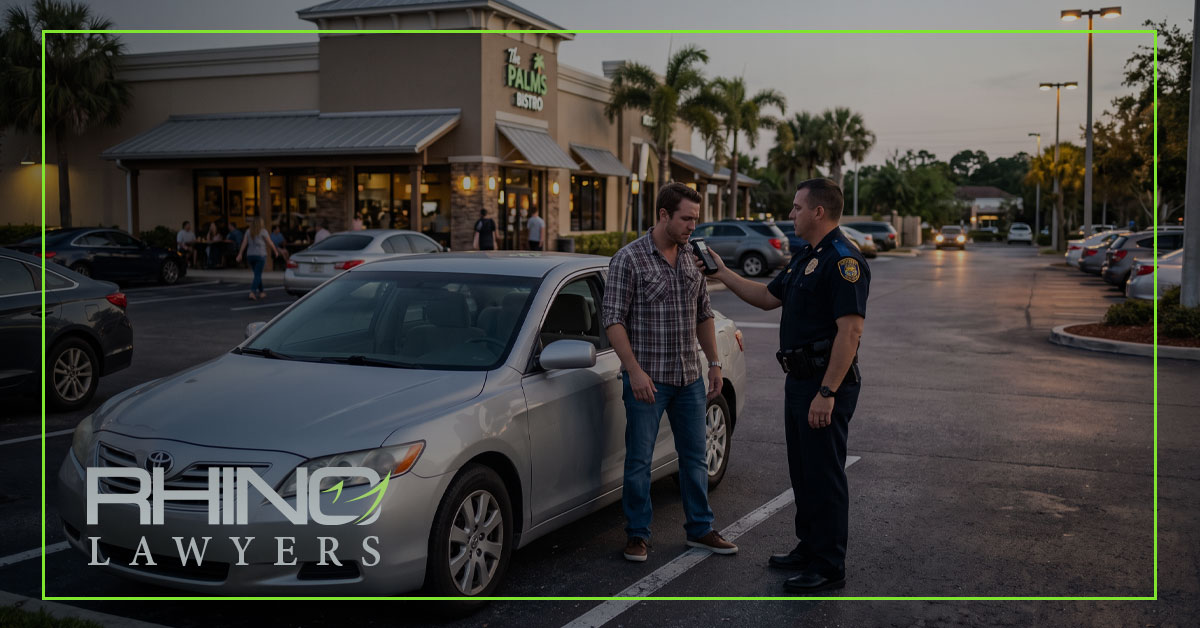
Imagine leaving a restaurant in St. Petersburg after dinner. You get behind the wheel and begin driving through the restaurant’s privately owned lot.
The fact that you haven’t reached the public street does not automatically prevent officers from investigating suspected DUI.
Gated and Residential Communities
Privately maintained roads can also create confusion.
A road inside a gated community may look and function much like any other neighborhood street, even though access is restricted or the property is privately maintained.
If law enforcement develops evidence that someone was driving or in actual physical control while impaired, simply pointing to the gate at the entrance may not resolve the DUI allegation.
Your Own Driveway
This is where the issue becomes especially surprising.
A DUI in a driveway in Florida may be legally possible depending on the facts.
That doesn’t mean sitting anywhere near a parked vehicle automatically equals DUI.
The key questions include what you were doing and whether you were driving or in actual physical control of the vehicle.
What Does “Actual Physical Control” Mean?
You don’t necessarily have to be driving down the road when police encounter you for a DUI investigation to begin.
Florida’s statute also uses the phrase actual physical control.
That can become a major issue in private-property cases.
The Car May Not Be Moving
Imagine police find someone sitting in the driver’s seat of a parked vehicle.
The engine is off.
No officer saw the vehicle moving.
Is DUI impossible?
Not necessarily.
The investigation may focus on whether the circumstances establish actual physical control rather than observed driving.
Relevant facts may include:
- Where the person was sitting.
- Where the keys were located.
- Whether the vehicle was operable.
- Where the vehicle was parked.
- Witness statements about earlier driving.
- Video showing how the vehicle arrived.
- Statements made to law enforcement.
No single fact should automatically be viewed in isolation.
A parked car can still create a DUI investigation.
What If You’re Sleeping It Off in Your Car?
This scenario deserves special attention because people sometimes believe sleeping inside the vehicle is always the safer legal alternative to driving.
Avoiding impaired driving is obviously important.
Yet from a criminal-defense perspective, the location and circumstances inside the vehicle can still matter.
Police May Investigate Actual Physical Control
Suppose someone realizes they should not drive and falls asleep in a vehicle parked outside a Tampa restaurant.
An officer later approaches and begins asking questions.
Potentially relevant facts could include:
- Whether the person is in the driver’s seat.
- Whether the keys are accessible.
- Whether the engine is running.
- Whether the vehicle can be driven.
- Whether witnesses saw the vehicle moving earlier.
- Whether surveillance cameras recorded the vehicle arriving.
The legal issue may shift from “Did the officer see you driving?” to “Can the State prove actual physical control?”
Those are not necessarily the same question.
How Can Police Investigate a DUI on Private Property?
A private-property DUI case may begin differently from a traditional roadside stop.
There might not be a traffic stop at all.
Someone Calls Police
Law enforcement could respond after:
- A parking-lot crash.
- A call from a security guard.
- A report from another driver.
- A business employee reporting suspicious behavior.
- A homeowner or neighbor calling police.
- A vehicle being found stopped in an unusual location.
Once officers arrive, they may begin gathering evidence.
Officers Look Beyond the Location
The investigation can include:
- Statements from witnesses.
- Surveillance footage.
- Body-camera recordings.
- Vehicle damage.
- Officer observations.
- Field sobriety exercises.
- Breath, blood, or urine evidence when legally obtained.
- Statements made by the person being investigated.
Florida’s implied consent law addresses chemical testing following qualifying DUI arrests and makes the distinction between driving and actual physical control important there as well.
The evidence may therefore extend far beyond whether the property was public or private.
What If Nobody Saw You Driving?
This is one of the most important questions in a DUI on private property Florida case.
An officer doesn’t always arrive while the vehicle is moving.
Circumstantial Evidence Can Matter
Suppose police arrive after a minor parking-lot collision.
Neither officer witnessed the crash.
Investigators may look for other evidence establishing who drove, such as:
- Admissions or statements.
- Passenger accounts.
- Independent witnesses.
- Security-camera recordings.
- Dashcam video.
- Vehicle location and damage.
- Receipts or other timing evidence.
The State may attempt to build its case using the complete set of circumstances rather than one officer’s direct observation.
At the same time, missing or conflicting evidence may create questions that deserve careful review.
That’s why the fact that “the police never saw me driving” doesn’t automatically end the analysis.
Drivers facing DUI allegations may also encounter driver’s license issues, chemical-testing questions, and other traffic-related consequences. RHINO Lawyers’ Florida traffic and DUI resources address many of those related issues in more detail.
Private property isn’t an automatic defense. But the specific facts surrounding driving, control, impairment, and the investigation can make all the difference.
Can a Private-Property DUI Charge Be Challenged?
Yes. The fact that Florida DUI law can apply on private property does not mean every arrest will result in a conviction.
The State still has to prove the required elements of the offense. In a private-property case, questions about who was driving, actual physical control, impairment, and how law enforcement obtained the evidence can become especially important.
Can the State Prove You Were Driving or in Control?
When no officer actually saw the vehicle moving, the evidence surrounding driving or actual physical control deserves close attention.
A defense attorney may examine:
- Whether anyone actually witnessed the driving.
- Where the vehicle was located when police arrived.
- Where the keys were found.
- Whether the vehicle was operable.
- Surveillance or security-camera footage.
- Statements from passengers or witnesses.
- Statements allegedly made by the accused driver.
For example, finding an impaired person near a vehicle is different from proving that person drove or had actual physical control of it.
The details matter.
Does the Evidence Actually Prove Impairment?
Location is only one part of a Florida DUI case.
Prosecutors must still establish impairment of normal faculties or qualifying blood- or breath-alcohol levels under Florida Statute 316.193.
Depending on the case, the defense may examine:
- Officer observations.
- Field sobriety exercises.
- Breath-test procedures.
- Blood or urine testing.
- Body-camera footage.
- Witness testimony.
- The timing of alcohol consumption.
A DUI allegation on private property still has to be supported by admissible evidence.
What If the DUI Started on a Public Road?
Some private-property DUI investigations begin after an officer or witness sees driving somewhere else.
A driver might turn from a public street into a parking lot, pull into an apartment complex, or reach a driveway before police make contact.
Reaching Private Property Doesn’t Erase Earlier Driving
Imagine an officer observes a vehicle weaving on a Tampa roadway. Before the officer initiates contact, the driver turns into a privately owned shopping center.
Being in a private parking lot when the interaction occurs doesn’t automatically erase what the officer allegedly observed on the public road.
Likewise, witnesses or surveillance cameras may provide evidence about earlier driving.
The Timeline Becomes Important
Private-property cases can involve several different moments:
- Where the vehicle was first observed.
- What witnesses saw.
- When law enforcement arrived.
- When alleged signs of impairment were observed.
- When chemical testing occurred.
That timeline may become particularly important when nobody directly observed the driver continuously.
Does a Private-Property DUI Carry Different Penalties?
Generally, being arrested on private property does not create a separate, lesser category of DUI.
The potential consequences depend on the DUI charge itself and the circumstances surrounding the case.
Florida DUI Penalties Can Be Serious
Depending on the facts and a person’s prior record, a DUI conviction may involve consequences such as:
- Fines.
- Probation.
- Driver’s license consequences.
- DUI school.
- Community service.
- Vehicle impoundment or immobilization.
- Ignition interlock requirements in qualifying cases.
- Possible incarceration.
Enhanced consequences can apply in circumstances addressed by Florida law, including certain cases involving higher alcohol levels, minors in the vehicle, prior convictions, crashes, serious bodily injury, or death.
Private ownership of the parking lot or driveway doesn’t automatically shield a driver from those consequences.
What Should You Do After a Private-Property DUI Arrest?
A DUI arrest can move quickly, and some deadlines—particularly those involving driving privileges—may arise before the criminal case is resolved.
Preserving information early can also matter.
Write Down What Happened
As soon as reasonably possible, document details such as:
- Where the vehicle was parked.
- Whether the engine was running.
- Where the keys were located.
- Who had been driving.
- Who was present.
- What officers asked.
- What testing was requested.
- Whether nearby cameras may have recorded the area.
Avoid posting details about the arrest or the events leading to it on social media.
Preserve Available Evidence
Private property often has something public roads may not: extensive surveillance.
Restaurants, hotels, apartment complexes, gated communities, stores, parking garages, and homeowners may have cameras pointed toward the location.
That footage may not be stored indefinitely.
Depending on the circumstances, preserving surveillance video, dashcam recordings, photographs, receipts, and witness information may help establish a more complete timeline of what occurred.
How RHINO Lawyers Can Help
A private property DUI in Florida can raise questions that don’t always appear in a typical roadside DUI arrest.
Was anyone actually driving? Could the State establish actual physical control? Where were the keys? Was the vehicle operable? What did witnesses see? Does surveillance footage support—or contradict—the allegations?
Those questions deserve more than assumptions based on where police found the vehicle.
At RHINO Lawyers, our criminal defense team reviews the circumstances surrounding the arrest, available video, witness accounts, chemical-test evidence, officer observations, and other facts that may affect a Florida DUI case.
If you’ve been arrested for DUI on private property in Florida, call (844) RHINO-77 for a free consultation. We’ll review what happened, explain the charges you’re facing, and discuss the legal options available in your case.
Frequently Asked Questions About DUI on Private Property in Florida
Can you get a DUI on private property in Florida?
Yes. Florida’s DUI statute applies to qualifying driving or actual physical control of a vehicle within the state. It is not limited exclusively to public highways.
Can you get a DUI in a private parking lot in Florida?
Yes. A privately owned restaurant, shopping center, hotel, apartment, or business parking lot does not automatically prevent a DUI arrest.
Can you get a DUI in your own driveway in Florida?
Potentially. The fact that the driveway is private property does not automatically prevent application of Florida’s DUI statute. The specific circumstances, including driving or actual physical control, remain important.
Can you get a DUI if the car isn’t moving?
Potentially. Florida’s statute covers both driving and being in actual physical control of a vehicle. Whether actual physical control can be established depends on the facts.
Can you get a DUI while sleeping in your car?
Police can investigate and potentially make a DUI arrest even when a person is found sleeping in a parked vehicle. Factors surrounding actual physical control can become important.
What if the police never saw me driving?
Lack of direct observation doesn’t automatically prevent prosecution. The State may rely on circumstantial evidence, witnesses, surveillance video, statements, or other evidence to attempt to establish driving or actual physical control.
Does being on private property make DUI penalties lower?
Private property does not automatically create a lesser DUI offense. Potential penalties generally depend on the charge, prior DUI history, and other circumstances covered by Florida law.
Can surveillance footage help a private-property DUI defense?
Potentially. Video could show when the vehicle arrived, who was driving, where the vehicle was parked, or other circumstances relevant to the allegations.
The Bottom Line: Private Property Isn’t a DUI-Free Zone
Can you get a DUI on private property in Florida? Yes.
A private parking lot, gated community, driveway, or other privately owned location does not automatically place someone outside Florida’s DUI statute.
But that isn’t the end of the analysis.
Private-property cases can create important questions about whether the State can prove:
- Who drove the vehicle.
- Whether the accused was in actual physical control.
- Whether impairment existed.
- Was chemical evidence properly obtained?
- Whether witnesses or surveillance footage support the allegations.
The location matters. The evidence matters more.
CONTACT TAMPA TRAFFIC TICKET ATTORNEY
RHINO Lawyers can help and guide you through a system molded by law enforcement, judges, and lawyers for decades. Having won cases for our clients in similar circumstances, our criminal defense team knows what it takes to fight on your behalf.
Let RHINO Lawyers answer your questions and review the facts of your case with a Free Consultation. So, get started by completing the “Free Instant Case Evaluation” or by calling us any time, day or night, at (844) RHINO-77.