

All Drivers Can Have Injuries Regardless of Fault.
PIP MEDICAL BENEFITS GENERALLY REQUIRE INITIAL QUALIFYING MEDICAL CARE WITHIN 14 DAYS AFTER THE ACCIDENT.
Even if you received a traffic citation after your accident occurred, this does not mean you are guilty. Nor does it mean you’re at fault or ineligible for certain benefits under the law. In fact, Florida’s unique laws enable us to assist almost anyone who has been recently injured as a result of a traffic crash.
If you have recently been in an auto accident, you may not feel the full extent of your injuries until weeks later. Therefore, if you even think you have injuries, we’ll immediately begin to help you preserve your benefits under Florida law.
REGARDLESS OF WHO MIGHT BE “AT-FAULT”.
First, stay calm and gather as much information as possible from the other driver involved in the accident. Otherwise, you may not be able to hold him or her responsible if they’re at fault. There is a process for determining fault, and it is best not to prematurely take responsibility for your accident.
Next, allow the process for determining fault to play out through official channels. Because even though you may think you were at fault for your accident, our investigation of the facts may reveal something different from what you initially expected.
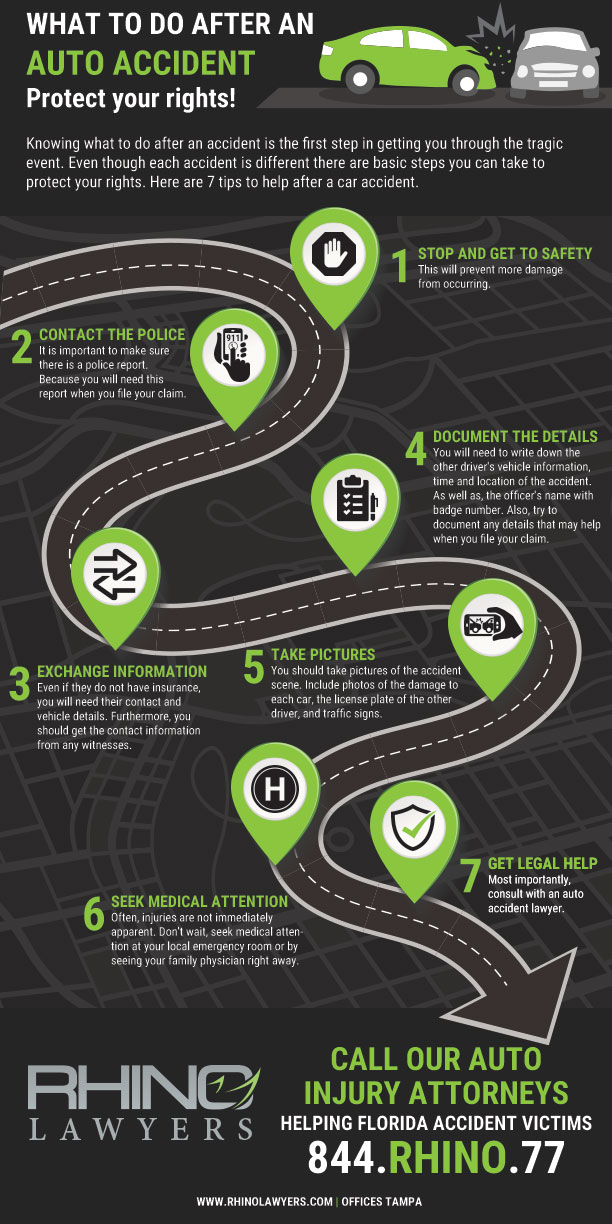
- Contact 911 or the local police.
- Collect the names, addresses, and telephone numbers from everyone involved and around the scene (e.g., independent witnesses), and the driver’s license number of the driver(s), license plate numbers of any vehicle involved, and any insurance info.
- Take photographs of any vehicle involved, injuries, and the accident location.
- If you think there is even a chance you might be injured, seek medical attention immediately.
- Contact our office ASAP so we can begin our crash investigation to help put you in the best position possible.
Click to enlarge.
YES, FOR THE MOST PART.
Having fear or rage immediately after an accident, you may feel the urge to discuss it. Try not to talk about your involvement in the accident, except with our office or your attorney.
We strongly suggest allowing official channels to be utilized in the process of determining fault. Even though you may think you were at fault for your accident, our investigation of the facts may reveal something different from what you initially expected. It is best not to prematurely take responsibility for your accident.
YES, FOR THE MOST PART.
If possible, you should report your accident to your insurance provider within 24 hours of your accident. However, keep in mind that there is a process for determining fault, and it is best not to prematurely take responsibility for your accident.
Even though you may think you were at fault for your accident, our investigation of the facts may reveal something different from what you initially expected. Allow the process for determining fault to play out through official channels.
THIS MAY NOT MATTER IN YOUR CASE.
The answer depends on vehicle ownership, household insurance, which vehicle was involved, and Florida’s PIP priority rules.
A person should not assume that lack of a policy in his or her own name automatically means no PIP coverage exists.
However, an owner of a motor vehicle who was legally required to maintain Florida’s no-fault security and failed to do so can lose the tort immunity provided by Florida’s no-fault law and can become personally liable for PIP benefits that would otherwise have been payable.
The applicable insurance policies and ownership information should be reviewed before determining what coverage is available.
Florida law places the security obligation on qualifying owners/registrants and specifically addresses an uninsured owner’s liability.
THIS MAY NOT MATTER IN YOUR CASE.
The other driver being uninsured does not automatically eliminate all available coverage.
Depending on Florida’s PIP priority rules and the policies involved, applicable PIP coverage may provide qualifying medical or disability benefits without regard to fault.
Uninsured/underinsured motorist coverage may also provide an additional source of recovery when it applies.
PIP should not be described as simply paying all accident bills up to $10,000. PIP generally provides up to $10,000 in combined medical and disability benefits, pays 80% of qualifying medical expenses, and generally pays 60% of qualifying lost income when that benefit has not been validly excluded. Medical reimbursement may be limited to $2,500 when there is no emergency medical condition.
THIS COULD MAKE OR BREAK AN INSURANCE SETTLEMENT.
Uninsured/underinsured motorist coverage, commonly called UM/UIM coverage, can protect an insured who is legally entitled to recover damages from a driver who has no bodily-injury liability insurance or does not have enough liability coverage to cover the insured’s damages.
Florida law generally requires UM coverage to be offered with qualifying bodily-injury liability policies unless it is properly rejected or lower limits are selected as allowed by law.
UM/UIM coverage is separate from PIP. Florida law provides that UM benefits are over and above, but may not duplicate, benefits available from PIP, applicable liability insurance, workers’ compensation, medical-expense coverage, or other specified sources.
Whether UM/UIM coverage applies and how much is available depend on the policy, selected limits, applicable exclusions, the damages, and the facts of the crash.
Florida is a no-fault state.
Florida’s Personal Injury Protection system provides certain benefits without regard to who caused the crash.
A qualifying PIP policy generally provides up to $10,000 in combined medical and disability benefits.
Medical benefits generally pay 80% of reasonable and medically necessary covered expenses when the statutory requirements are met. Initial qualifying medical services and care generally must be received within 14 days.
Medical reimbursement may be available up to the applicable $10,000 limit when an authorized provider determines that the injured person had an emergency medical condition. Without an emergency medical condition, medical reimbursement is generally limited to $2,500.
PIP disability benefits generally pay 60% of qualifying lost gross income and loss of earning capacity, although Florida permits a named insured to elect an exclusion of those lost-income benefits in specified circumstances.
Which PIP policy applies depends on the facts and Florida’s statutory priority rules.
Luckily, you always have the right to pursue the individual(s) who negligently caused injury to you. Even though a negligent driver may not carry bodily injury coverage to compensate you in an automobile collision. Actually, they may have personal assets to pursue to make you whole. An attorney can perform a thorough investigation. And help guide you through the process of suing and recovering damages you sustained in a collision.
Not necessarily.
Although your premium may increase because of a collision, it is not necessarily a guarantee. However, auto insurance premiums tend to increase over time. Even without an automobile collision.
In fact, many factors contribute to these increases, including general market trends. Other factors that may increase rates include address changes, new vehicles, and auto claims filed in your zip code by other drivers. Thus, it is recommended that you get various quotes every six months or annually. This will ensure you are getting the best rates.
As personal injury attorneys, we work on a contingency fee basis. In fact, the Florida Supreme Court regulates contingency fees. Tapering these fees on a sliding scale depending on the amount recovered.
Actually, the standard fee for an insurance claim is 33.33%. And, the standard fee for a case in which a lawsuit is filed is 40%. Thus, a contingency fee agreement means that the attorney is owed nothing unless there is a successful recovery in your case. Therefore, there are no out-of-pocket or upfront costs associated with retaining our services.
Having prior injuries and/or medical treatment does not prohibit you from making a claim. In fact, insurance companies and defense attorneys will attempt to use this as an excuse. So they can avoid compensating you for the damages you sustained in an accident. But, Florida law permits you to make a claim for temporary and permanent worsening of your underlying medical conditions. Thus, it is important to contact an attorney, as many cases involving pre-existing conditions result in lawsuits.
If you sustain an injury in an accident, you should not speak with an adjuster. In fact, wait until you have had the opportunity to discuss the incident with an attorney. Because adjusters will attempt to minimize the impact of any alleged injuries in a collision. And they will ask questions designed to make you admit fault and admit that you were not injured. An attorney can contact adjusters directly on your behalf and avoid this questioning.
YOU HAVE OPTIONS
Luckily, you will have some options for making repairs to your vehicle. Now, if the damages or total loss fall within the property damage coverage of the at-fault driver, then that insurance carrier should be responsible for making repairs or paying for the total loss. But only up to the limits of their property damage policy coverage. Because insurance carriers will oftentimes also provide rental coverage during the repairs. Or for a period of time while the total loss is being evaluated.
Alternatively, if the person who was at fault does not have enough property damage coverage, or the determination of fault is taking an extended period of time. Then you may choose to use your collision insurance coverage. If you have purchased this type of coverage on your policy. Although many times, if you have a loan on your vehicle or if you lease the vehicle, this type of coverage is mandatory to provide to your lienholder or leasing company.
But you will very likely still have to pay for your deductible. Which the at-fault insurance carrier may ultimately reimburse once determining the total fault. Lastly, they will only provide you with a rental vehicle under your insurance coverage if you have elected rental coverage on your policy.
Florida PIP generally provides 60% of qualifying lost gross income and loss of earning capacity caused by a covered injury, subject to the applicable PIP limit, deductible, policy terms, and statutory requirements.
However, Florida law allows the named insured to elect an exclusion of lost-income benefits in exchange for a premium reduction. The actual policy should therefore be reviewed to determine whether lost-income coverage is available.
Depending on fault, damages, and available insurance, additional lost-income damages may also be recoverable from a legally responsible party or through applicable UM/UIM coverage.
Especially if you were not at fault, your insurance should not raise your premium if you decide to have your vehicle repaired through your insurance policy under your collision coverage. Yet, insurance companies typically evaluate premium changes for many reasons. And those reasons change from carrier to carrier. So, it may be difficult to pinpoint exactly where your increased premium is coming from. Particularly, in the event that your premium increases after your auto accident.
Unfortunately, this answer depends on many variables because every case is different. However, personal injury law industry-standard timelines hover between about 9 and 12 months.
Although a prior injury may affect the way an insurance company or attorney views your claim. It does not prohibit you from making a claim. In fact, you may have sustained an exacerbation or aggravation of your pre-existing injury or condition. Or, you may have sustained a wholly distinct injury that will likely not be discovered unless you seek medical treatment. So, if you believe you have been injured in a collision, you should seek medical help and the advice of an attorney.
For qualifying PIP medical benefits, initial services and care generally must be received within 14 days after the motor-vehicle accident.
Florida law identifies the types of licensed providers and facilities that may provide qualifying initial and follow-up care. Covered medical expenses are generally reimbursed at 80%, subject to the statute, policy terms, applicable deductibles, coverage limits, exclusions, and medical-necessity requirements.
PIP generally provides up to $10,000 in combined medical and disability benefits. Medical reimbursement is generally limited to $2,500 when the injured person is determined not to have an emergency medical condition.
The applicable PIP insurer and coverage priority depend on vehicle ownership, household coverage, occupancy, and other facts.
We’re Here to Help You.
Our former Insurance Defense Attorney, Brandon F. Jones, knows how the insurance companies place a value on traffic crash injuries and vehicle damage. If you were involved in a Tampa auto accident, we’ll leverage our full understanding of Personal Injury Law to help you establish that the other driver involved in the traffic crash was at fault, or at least responsible for a portion of your damages or injuries.
CONTACT RHINO LAWYERS NOW
BOLD REPRESENTATION. BOLD RESULTS.
Get the answers YOU need by speaking or meeting with one of our former insurance defense attorneys who have inside knowledge of how big insurance companies value personal injury and damage claims. No fees unless we WIN.
So, get YOUR Free Case Analysis now by texting us, chatting with us online, completing the form below, or by calling 844.RHINO.77.
Then, decide what is best after getting free advice from a RHINO Lawyer who wants to help YOU.
Free Case Evaluation
Legal problems can feel overwhelming, but you don’t have to face them alone. At RHINO Lawyers, we take the time to listen, answer your questions, and provide the support you need during a difficult time.