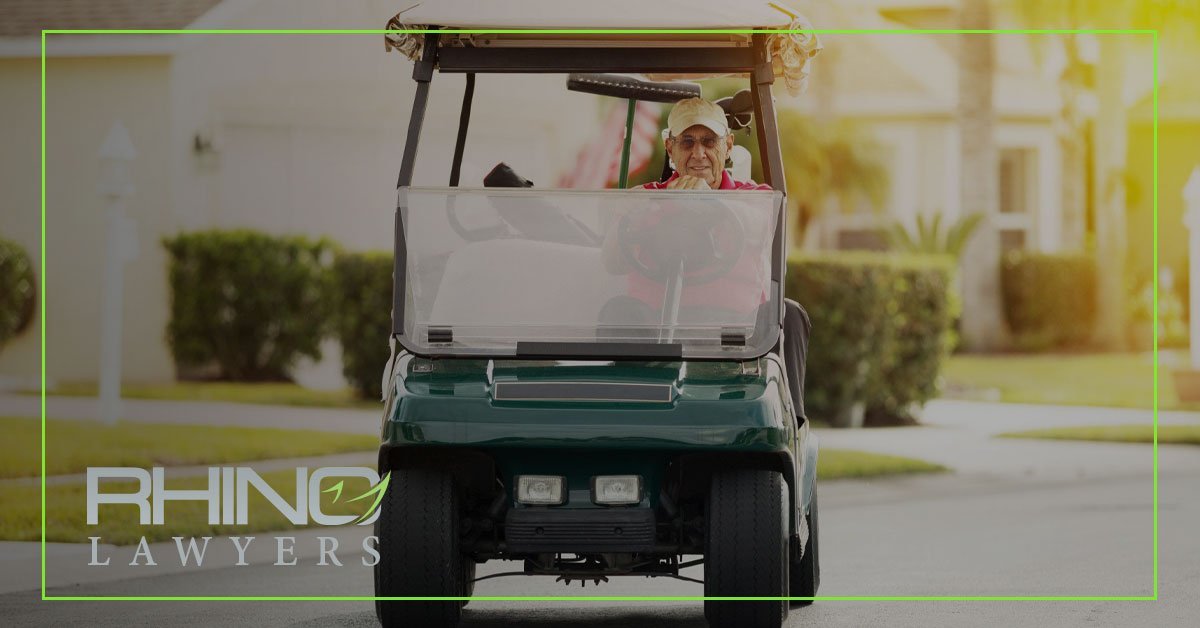
The Rules of the Road for Golf Carts
Annually, fifteen thousand people obtain a golf cart accident injury. That’s about 288 people per week. But it’s easy to avoid becoming an accident victim when you follow the rules of the road- both on and off the golf course.
Keep reading to learn about age requirements, equipment rules, and registration golf cart laws in Florida.
What Is the Difference Between a Golf Cart and a Low-Speed Vehicle?
Florida law treats golf carts and low-speed vehicles differently.
A golf cart is a motor vehicle designed and manufactured for golf-course or recreational use that cannot exceed 20 mph. A low-speed vehicle (LSV) is a four-wheeled vehicle with a top speed greater than 20 mph but not greater than 25 mph.
That distinction matters because LSVs have different licensing, equipment, registration, and insurance requirements.
Conditions of Operating on Roadways
You can’t drive them on public roads in Florida, except under specific conditions found in Fla. Stat. 316.212. According to law, golf cart usage on public roads is not permitted except for the following:
- On a county road or municipal street designated for use by golf carts
- To cross a state highway intersecting a county road or municipal street designated for golf cart usage
- Crossing a state highway at midblock when a golf course is on both sides of the highway
- On a state road, if the DOT determines golf cart use does not impede traffic flow
- Crossing a street or highway where a single mobile home park is on both sides of the roadway
- On a state park road system, if the speed limit is 35 mph or less
- Operation only allowable from sunrise to sunset
- Nighttime driving is only allowable with government authorization and on carts equipped with headlights, brake lights, turn signals, and a windshield
Golf carts operating on public roads must have efficient brakes, safe tires, reliable steering, rearview mirrors, and reflectorized warning devices on the rear and front. Drivers must follow all traffic laws and maintain the posted speed.
When using designated golf cart crosswalks intersecting a roadway, you must yield to pedestrians and cross-vehicle traffic.
Avoid operating golf carts in bad weather. Heavy rain can cause slick roads and flooding, increasing safety risks.
Prohibited Areas
You cannot operate golf carts on roads with speeds over 30 mph. It is illegal to drive on sidewalks unless designated for that purpose. Local government entities may obtain authorization from the Department of Transportation to allow the use on sidewalks.
Local ordinances must restrict the golf cart speed to 15 mph, and the sidewalks must be at least eight feet wide. Fla. Stat §316.212(b) requires posting signs that usage includes golf carts.
Golf carts using sidewalks must meet all equipment requirements for street usage. Additional safety requirements may include a horn or other warning device.
Who Can Drive a Golf Cart on a Public Road?
Under Florida Statute §316.212, a person under age 18 may not operate a golf cart on a public road or street unless the person has a valid learner’s driver license or driver license. A driver age 18 or older must possess valid government-issued photographic identification.
Operating Under the Influence
You cannot operate your golf cart on public roads when under the influence of drugs or alcohol. Law enforcement may pull you over and conduct a sobriety test if they believe you are intoxicated. If the officer determines you are under the influence, he or she can charge you with a DUI.
Passengers
Florida law requires every person in a golf cart to have their own seat. There is no seat sharing or holding children on a lap.
Every seat must have a seatbelt, and all occupants must wear seatbelts on roadways. Children three years or under must be in a car seat. The state recommends using a booster seat for children over age four, but this is not a legal requirement.
Required Equipment for a Standard Golf Cart
A golf cart operated under §316.212 must have:
- efficient brakes;
- reliable steering;
- safe tires;
- a rearview mirror; and
- red reflectorized warning devices in the front and rear.
Golf carts generally may operate only between sunrise and sunset unless the responsible governmental entity permits nighttime operation. For authorized nighttime driving, the golf cart must also have headlights, brake lights, turn signals, and a windshield.
Local governments may impose additional restrictions.
Does a Florida Golf Cart Need a Title and Registration?
A standard golf cart operating under Florida’s golf-cart rules is different from an LSV and is not automatically subject to the state title and registration requirements that apply to an LSV.
If a golf cart is modified so that it qualifies as a low-speed vehicle, different rules apply. An LSV must meet applicable safety requirements and must be titled and registered.
Does a Florida Golf Cart Need PIP and Property-Damage Insurance?
Florida requires an LSV to be properly registered and insured, including the required Personal Injury Protection and Property Damage Liability coverage. A standard golf cart is not subject to those LSV insurance requirements merely because it is lawfully operated as a golf cart under §316.212.
Local rules and an owner’s insurance needs can still vary, so check the requirements that apply where the golf cart will be operated.
If You Are in an Accident
When operating a golf cart on public roads in Florida, it is essential to comply with all Florida laws. Even the most cautious driver can become the victim of an accident.
If you suffer injuries in a golf cart accident, contact RHINO Lawyers for a free case analysis. We will negotiate your settlement or take the matter to trial while you recover. Call 844.RHINO.77 today.
CONTACT A TAMPA AUTO ACCIDENT ATTORNEY
In short, after a car accident, you may not know your rights. Above all, don’t struggle through the process alone. Actually, our personal injury team is here to help you with any legal needs you might have regarding your accident.
Lastly, let RHINO Lawyers answer your questions and review the facts of your case with a Free Consultation. So, get started by completing the “Free Instant Case Evaluation” or by calling us any time, day or night, at 844.RHINO.77.